Levels of Work
Why the same competency changes meaning by horizon
The same word can name a different discipline depending on how long a person must hold judgment before results can be judged. Levels of Work gives that difference a structure instead of leaving it to guesswork.
People naturally narrow their thinking when work exceeds the complexity the organization has made explicit for their role. Rather than reach for higher-order integration, judgment tends to retreat toward what still feels controllable: shorter horizons, checkable tasks, premature certainty. This is not a character flaw. It is a predictable response to unmanaged complexity, and it is exactly what Levels of Work is built to make visible.
The clearest anchor for this structure is Time Span of Discretion, a concept drawn from Elliott Jaques's research: how long someone must carry a decision on their own before its outcome can be fairly judged. Gillian Stamp extended this tradition by examining how individuals structure complexity and time delay in their own reasoning, giving leaders a way to see fit and mismatch clearly rather than moralize about them. Time span is not about how long a plan lasts on paper. It is about how long a person must carry uncertainty before anyone can know whether their judgment was sound.
Competency language flattens without this lens. A word like accountability, judgment, or communication can describe a completely different discipline depending on whether the horizon is a single shift or a multi-year strategic bet. Without Levels of Work, organizations end up applying the same expectations, the same review cadence, and the same definition of good judgment to roles that are, structurally, nothing alike.
Mismatch between a role's true complexity and the way a person naturally structures reasoning produces friction, but that friction is a design signal, not a verdict on character. A role can quietly drift upward in complexity without ever being redesigned, and a capable person can begin to look like they are struggling when the real issue is that the work outgrew the role faster than the organization noticed.
Levels of Work
Levels of Work 1–5
-
Level 1 — Quality
Immediate, same-day judgment
Work here is concrete and procedural: executing a known method cleanly and catching deviations early. The horizon is short enough that outcomes can be judged almost immediately.
-
Level 2 — Service
Days to weeks, within policy
The role shifts from performing tasks to coordinating and adjusting them, translating plans into repeatable performance. Judgment here operates inside policy rather than inventing it.
-
Level 3 — Practice
Months, across repeated cycles
This level splits in two. Practice as Continuous Improvement tightens flow and cuts waste inside the current system. Practice as Innovation questions whether that method can still carry what conditions now demand.
-
Level 4 — Strategic Development
Multi-year, cross-functional
The work becomes architectural, designing systems, structures, and pathways where interdependence must be held consciously. Consequences here are more distributed and more delayed than at earlier levels.
-
Level 5 — Strategic Intent
Long-range, organization-shaping
This level also splits. Strategic Intent as Direction sets trajectory and arena under uncertainty, while Strategic Intent as Viability validates whether that trajectory can survive contact with capital, capacity, and reality.
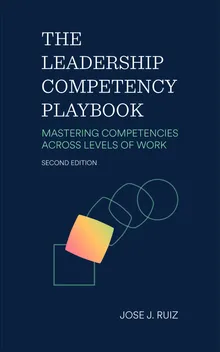
Second Edition — available now
Read the second edition
Twenty-four competencies, read through the DOES cycle and the Levels of Work. The full architecture, chapter by chapter.
Available in paperback and Kindle.